Applying to KAUST - Your Complete Guide for Masters & Ph.D. Programs (Upcoming Admissions)
Admissions Overview & Key Requirements


The number of educated people in a country is often linked to how prosperous that nation will be. Whether in terms of productivity or innovation, a more educated workforce can make a greater contribution to a country's overall economy.
Millions of people between the ages of 25 and 64 worldwide hold a bachelor's degree. This article presents a list reflecting which countries and territories have the highest rates for this indicator.
This statistic is based on the percentage relative to the total population of each country and territory, rather than the raw number of individuals. For example, although the number of people with a bachelor's degree in India is higher than the combined total of the top 11 countries, India does not make the top 30 because these individuals constitute less than 15% of the country's population.
So, which countries and territories are on the list?
The Top 10
1. Ireland
Ireland ranks first—an amazing 52.4% of the workforce here holds a bachelor's degree! Public universities in Ireland offer affordable, modern, and research-based education. The country also possesses one of the world's strongest economies, which is a clear indicator of this success.
2. Switzerland
Approximately 46% of the workforce aged 25–64 in Switzerland has obtained a bachelor's degree. With prestigious universities located in cities like Zurich and Lausanne, Switzerland is known for its excellence in science, engineering, and business.
3. Singapore
Singapore is the highest-ranking Asian country on this list at 45%. Universities in this small but powerful nation hold high global rankings. The education system is characterized by being results-oriented and highly funded.
4. Belgium
Approximately 44.1% of Belgium's workforce has a higher education. The multilingual higher education system serves diverse student groups, and public universities combine regional advantages with prestigious business programs.
5. United Kingdom
The United Kingdom enters the top five with a rate of 43.6%. Elite higher education institutions such as Oxford and Cambridge define the country as a strong destination for higher education, despite facing funding challenges in recent years.
6. Netherlands
Approximately 42% of the workforce in the Netherlands has received a higher education. Universities are typically affordable for European Union students, classes are widely taught in English, and there is a special emphasis on internationalization.
7. United States
Approximately 40.3% of the population aged 25–64 in the US has earned a bachelor's degree. This equates to about 78.2 million people. Home to many top-ranked public and private universities globally, the US offers vast opportunities. However, tuition fees and student debt are significant downsides.
8. Australia
In Australia, higher education graduates account for 39.8%. The “Group of Eight” (a coalition of the country's leading universities) is globally recognized for research and the integration of international students. Costs can be high, but the quality of education is strong and balanced.
9. Israel
The percentage of higher education graduates in Israel is 39.7%. Public universities offer strong technology and business education with high research activity.
10. Sweden
The last Scandinavian country to enter the top 10 is Sweden—where 39.6% of the workforce has completed higher education. Tuition-free public universities promote equality and innovation, possess a strong international orientation, and particularly excel in research and creative thinking.
Share
Applying to KAUST - Your Complete Guide for Masters & Ph.D. Programs (Upcoming Admissions)
Admissions Overview & Key Requirements

An mRNA cancer vaccine may offer long-term protection
A small clinical trial suggests the treatment could help keep pancreatic cancer from returning

Registration Opens for SAF 2025: International STEAM Azerbaijan Festival Welcomes Global Youth
The International STEAM Azerbaijan Festival (SAF) has officially opened registration for its 2025 edition!
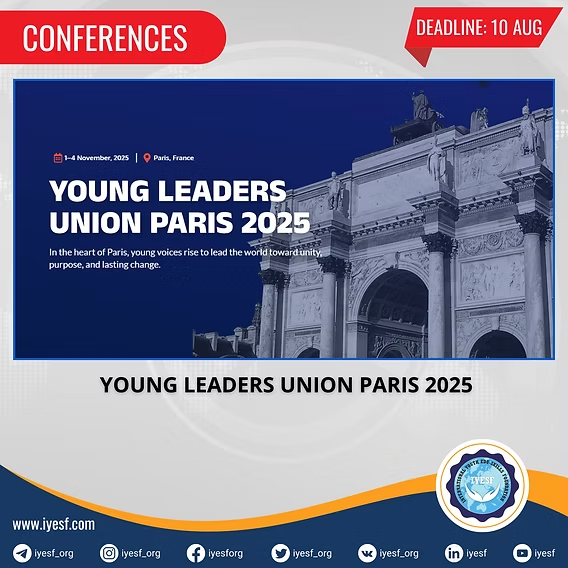
Young Leaders Union Conference 2025 in Paris (Fully Funded)
Join Global Changemakers in Paris! Fully Funded International Conference for Students, Professionals, and Social Leaders from All Nationalities and Fields

Yer yürəsinin daxili nüvəsində struktur dəyişiklikləri aşkar edilib
bu nəzəriyyənin doğru olmadığı məlum olub. Seismik dalğalar vasitəsilə aparılan tədqiqatda daxili nüvənin səthindəki dəyişikliklərə dair qeyri-adi məlumatlar əldə edilib.

Lester B Pearson Scholarship 2026 in Canada (Fully Funded)
Applications are now open for the Lester B Pearson Scholarship 2026 at the University of Toronto!