Applying to KAUST - Your Complete Guide for Masters & Ph.D. Programs (Upcoming Admissions)
Admissions Overview & Key Requirements


File: Raghav Foundation
According to The Guardian, a new scientific study carried out in the United Kingdom has found that children who are subjected to physical punishment by their parents achieve poorer academic results and are more likely to develop violent behavior later in life. Researchers say these findings strengthen calls for a ban on “smacking” children. The study, based on data from 19,000 children born in the UK in the early 2000s, also found that teenagers who experienced physical punishment at an early age were more likely to engage in antisocial behavior such as bullying siblings and others, including cyberbullying.
The research notes that the use of physical punishment by parents is still widespread, with more than 20% of 10-year-olds having experienced it in 2020–2021. It is believed that the rate is even higher among younger children. According to the findings, the effects of physical punishment are most visible in early childhood as behavioral problems. Children who experience repeated physical punishment also show weaker reading and writing skills. The study also found that children who were physically punished were less likely to pass at least five GCSE subjects (including English and Mathematics). Statistically, 48% of those exposed to physical punishment failed to achieve this benchmark, compared with 42% of those who were not exposed.
Experts say this difference is particularly more pronounced among boys. The study also shows that teenagers who experienced physical punishment were more likely to engage in aggressive behavior, vandalism, and bullying. Dr. Anja Heilmann, the lead researcher at UCL, said these findings provide strong arguments for removing the legal defense of “reasonable punishment” in England and Northern Ireland. She stated that children should be protected from all forms of violence. Under current UK law, parents can avoid legal responsibility for hitting their children by claiming “reasonable punishment.” However, this practice has already been banned in Scotland and Wales.
The UK Department for Education said that new laws would strengthen child protection, but confirmed that there are currently no plans to introduce a full ban on smacking. The researchers concluded that the continued use of physical punishment on children may have negative consequences not only for individuals but also for society as a whole.
Share
Applying to KAUST - Your Complete Guide for Masters & Ph.D. Programs (Upcoming Admissions)
Admissions Overview & Key Requirements

An mRNA cancer vaccine may offer long-term protection
A small clinical trial suggests the treatment could help keep pancreatic cancer from returning

Registration Opens for SAF 2025: International STEAM Azerbaijan Festival Welcomes Global Youth
The International STEAM Azerbaijan Festival (SAF) has officially opened registration for its 2025 edition!
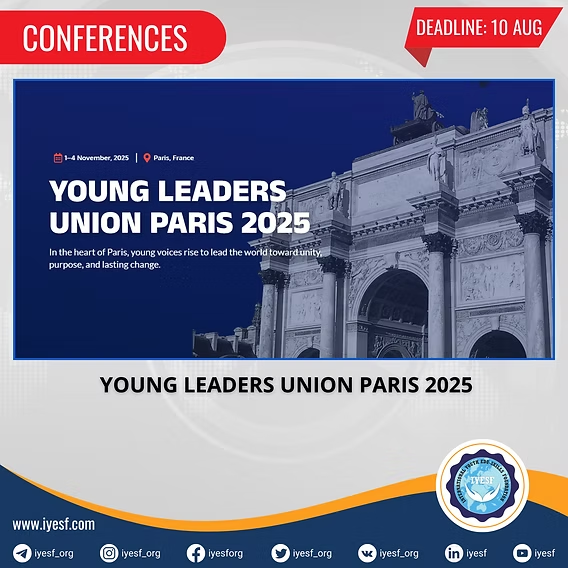
Young Leaders Union Conference 2025 in Paris (Fully Funded)
Join Global Changemakers in Paris! Fully Funded International Conference for Students, Professionals, and Social Leaders from All Nationalities and Fields

Yer yürəsinin daxili nüvəsində struktur dəyişiklikləri aşkar edilib
bu nəzəriyyənin doğru olmadığı məlum olub. Seismik dalğalar vasitəsilə aparılan tədqiqatda daxili nüvənin səthindəki dəyişikliklərə dair qeyri-adi məlumatlar əldə edilib.

Lester B Pearson Scholarship 2026 in Canada (Fully Funded)
Applications are now open for the Lester B Pearson Scholarship 2026 at the University of Toronto!