Applying to KAUST - Your Complete Guide for Masters & Ph.D. Programs (Upcoming Admissions)
Admissions Overview & Key Requirements


Nuclear education/ Innovation News Network
The U.S. Department of Energy is investing $50 million to expand nuclear energy education across the Great Lakes region. The funding will support partnerships between multiple universities, develop new programs, and help train the next generation of nuclear energy professionals.
“I just think the energy field is going to be a very exciting field for young people to work in going forward, and we have to let them know it exists,” said Representative Marcy Kaptur. The investment comes as industry experts anticipate growing demand for nuclear energy in the coming years.
Gary Leidich, chair of the Great Lakes Partnership to Enhance the Nuclear Workforce Advisory Board, emphasized the need for reliable power. “We need that baseload capacity back. A lot of that load growth comes from data centers. Electrical vehicles, I’m not so sure about anymore, but the data center load growth is spectacular across the whole country,” he said.
A significant portion of the funding will go to the University of Toledo, which received $19.2 million—the largest federal award in the university’s history. “We will be hiring new faculty, offering new certificates, and developing new courses,” said University of Toledo president Frank Calzonetti. Students will also benefit from co-op and internship opportunities at nuclear sites, including the Davis-Besse nuclear plant.
The initiative spans beyond northwest Ohio, with the University of Michigan expanding its digital simulation labs. Todd Allen from the university explained, “These labs allow people to practice running reactors and learn the consequences. Artificial intelligence, which is going to be part of modern industry, will also be integrated into nuclear training.”
Kaptur highlighted the importance of the investment for the region. “The Great Lakes currently produce one-third of the United States’ nuclear power. There couldn’t be a more important industry with skilled workers than this one that connects to every household, every business, every classroom, every health facility,” she said.
Share
Applying to KAUST - Your Complete Guide for Masters & Ph.D. Programs (Upcoming Admissions)
Admissions Overview & Key Requirements

An mRNA cancer vaccine may offer long-term protection
A small clinical trial suggests the treatment could help keep pancreatic cancer from returning

Registration Opens for SAF 2025: International STEAM Azerbaijan Festival Welcomes Global Youth
The International STEAM Azerbaijan Festival (SAF) has officially opened registration for its 2025 edition!
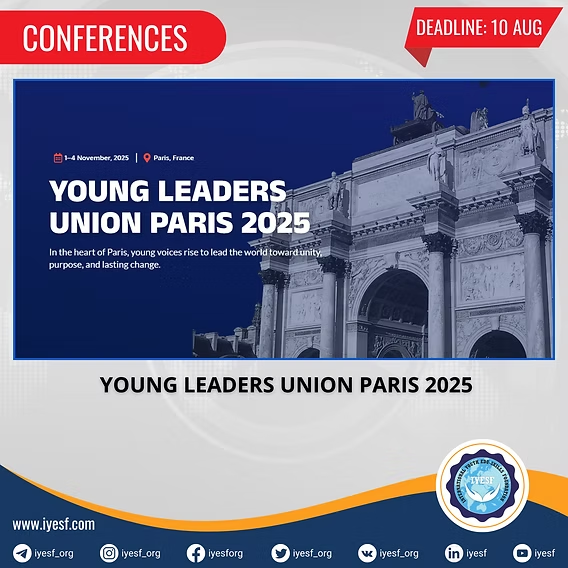
Young Leaders Union Conference 2025 in Paris (Fully Funded)
Join Global Changemakers in Paris! Fully Funded International Conference for Students, Professionals, and Social Leaders from All Nationalities and Fields

Yer yürəsinin daxili nüvəsində struktur dəyişiklikləri aşkar edilib
bu nəzəriyyənin doğru olmadığı məlum olub. Seismik dalğalar vasitəsilə aparılan tədqiqatda daxili nüvənin səthindəki dəyişikliklərə dair qeyri-adi məlumatlar əldə edilib.

Lester B Pearson Scholarship 2026 in Canada (Fully Funded)
Applications are now open for the Lester B Pearson Scholarship 2026 at the University of Toronto!