Applying to KAUST - Your Complete Guide for Masters & Ph.D. Programs (Upcoming Admissions)
Admissions Overview & Key Requirements

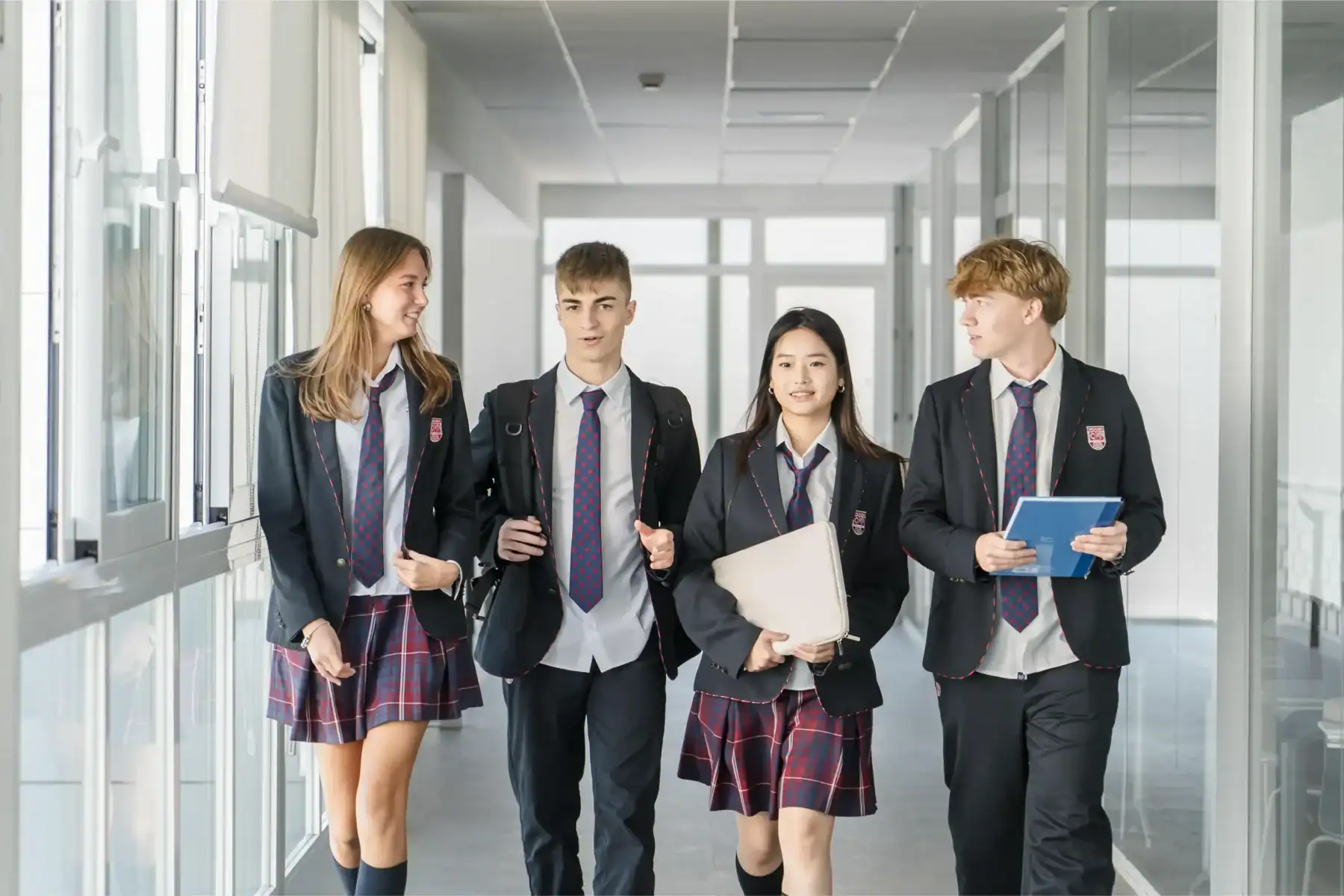
Students at the school/ File: World Schools
Primary education
In Spain, primary education begins at age six and continues until age 12. It is structured as a six-year program divided into three cycles.
During the first cycle, students receive strong guidance as they learn foundational skills such as reading, writing, and basic mathematics. In the second cycle, they begin applying these skills more independently. By the final cycle, pupils deepen their understanding of subjects in preparation for secondary school.
By contrast, British international schools in Spain introduce formal education earlier, often starting with reception at ages four or five. Students then progress through Key Stage One, where they build literacy and numeracy skills, followed by Key Stage Two from age seven, where they begin linking classroom knowledge to real-world contexts.
Secondary education
Spanish secondary education, known as Educación Secundaria Obligatoria (ESO), runs from ages 12 to 16 and is divided into two cycles over four years.
In the first cycle, students consolidate core academic knowledge while being introduced to practical subjects. In the second cycle, they select optional subjects such as languages, music, or technology. Assessment is continuous, based on homework, class participation, and exams. Students who fail subjects may retake them during the summer; failing again typically means repeating the academic year.
Upon successful completion, students receive the Título de ESO, the official secondary school qualification in Spain.
In British international schools, secondary education begins with Key Stage 3, where students expand their academic foundation and explore subjects like computing and design technology. By age 14, students prepare for IGCSE examinations, taken at 16, where each subject is graded individually.
Unlike the Spanish system, IGCSE assessment relies almost entirely on final exams, with little or no coursework. This can be challenging for students who struggle under exam pressure, making the Spanish model a potentially better fit for some learners.
Post-16 pathways
After compulsory education, Spanish students typically pursue the two-year Bachillerato program, choosing one of three academic tracks: science and technology, humanities and social sciences, or the arts. While this system provides clear direction, it offers limited flexibility. All students continue studying Spanish, a foreign language, and physical education.
In British international schools, students instead work towards A Levels. Typically selecting three or four subjects, they focus in depth on chosen areas over two years, culminating in a series of final exams.
University access
The Spanish system offers a direct pathway to public universities through Bachillerato. Admission is based on Bachillerato results and performance in the EBAU (Evaluación de Bachillerato para el Acceso a la Universidad), a mandatory university entrance exam.
Students aiming to study abroad, particularly in the UK, must present strong EBAU scores alongside proof of English proficiency.
In contrast, A Level qualifications from international schools are widely recognized by leading universities in the UK, the United States—including Ivy League institutions—and across Europe, making them a clearer route for international higher education.
However, students from international schools wishing to attend Spanish public universities must demonstrate advanced Spanish proficiency and have their qualifications officially recognized by Spain’s Ministry of Education.
Beyond the classroom
Differences between the two systems extend beyond academics. Spanish schools often foster strong community ties, with students progressing through cycles together and living in the same neighborhoods. Children are immersed in Spanish language and culture, which helps them achieve fluency over time, even if initial adjustment is challenging.
International schools, on the other hand, offer culturally diverse environments, with students from various backgrounds. This diversity creates a welcoming atmosphere where friendships form quickly. However, these relationships can be more transient due to the mobility of expatriate families, and students may have less connection to the local community.
Extracurricular activities also differ. Spanish students often participate in local clubs outside school, while international schools tend to offer a wider range of on-campus activities, making school the central hub of students’ social lives.
The choice between Spanish and British international schools depends on a family’s priorities—whether they value cultural integration and continuous assessment, or international mobility and exam-based qualifications. For many parents, the decision remains a complex and deeply personal one.
Source: The Olive Press
Share
Applying to KAUST - Your Complete Guide for Masters & Ph.D. Programs (Upcoming Admissions)
Admissions Overview & Key Requirements

An mRNA cancer vaccine may offer long-term protection
A small clinical trial suggests the treatment could help keep pancreatic cancer from returning

Registration Opens for SAF 2025: International STEAM Azerbaijan Festival Welcomes Global Youth
The International STEAM Azerbaijan Festival (SAF) has officially opened registration for its 2025 edition!
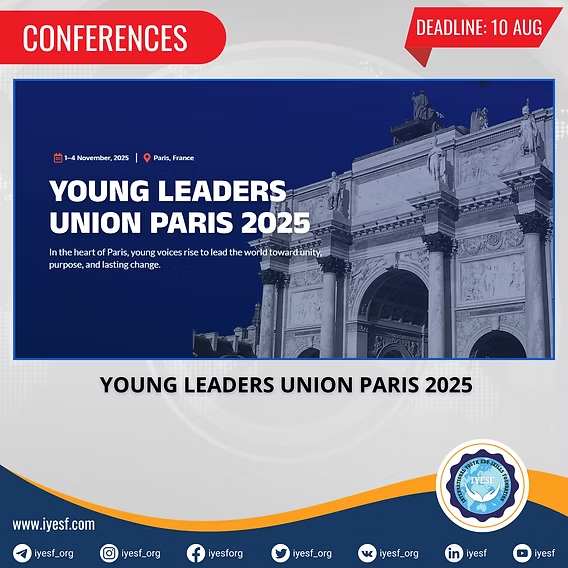
Young Leaders Union Conference 2025 in Paris (Fully Funded)
Join Global Changemakers in Paris! Fully Funded International Conference for Students, Professionals, and Social Leaders from All Nationalities and Fields

Yer yürəsinin daxili nüvəsində struktur dəyişiklikləri aşkar edilib
bu nəzəriyyənin doğru olmadığı məlum olub. Seismik dalğalar vasitəsilə aparılan tədqiqatda daxili nüvənin səthindəki dəyişikliklərə dair qeyri-adi məlumatlar əldə edilib.

Lester B Pearson Scholarship 2026 in Canada (Fully Funded)
Applications are now open for the Lester B Pearson Scholarship 2026 at the University of Toronto!