
Applying to KAUST - Your Complete Guide for Masters & Ph.D. Programs (Upcoming Admissions)
Admissions Overview & Key Requirements


Starting in April 2026, teachers across Poland will face a new obligation: schools will introduce a mandatory functional assessment for every student. According to the Ministry of Education (MEN), the new tool is intended to help teachers better adapt teaching methods to the real abilities and needs of children. Each teacher will be required to complete a specially designed assessment form.
The questionnaire will include questions about how a student communicates with teachers, how they function within their peer group, their individual educational needs, and areas where they might require additional support. The Ministry believes that this system will make it easier to identify students facing various challenges and to tailor support more effectively.
The functional assessment is meant to give a more complete picture of a student’s developmental capabilities, needs, and interests. According to MEN, its purpose is to support the creation of an educational environment that fosters a child’s development, improves learning outcomes, and strengthens their sense of self-worth. The Ministry emphasizes that this is not a new element of the education system but rather a formalization and reinforcement of duties that teachers already have under existing legislation.
Polish education law already requires teachers to recognize students’ individual developmental and educational needs, their psychological and physical capabilities, as well as their strengths, talents, interests, and predispositions. Teachers are also responsible for diagnosing the causes of learning or behavioral difficulties, planning support measures, developing students’ competencies, and individualizing the teaching process. MEN has announced that it will regularly provide schools with materials and tools to support the implementation of functional assessment. The goal is to better utilize each student’s potential and improve support for their development.
Functional assessment focuses on a holistic description of how a student functions in everyday school and social life, rather than only on academic results or medical diagnoses. The assessment process will gather diverse data about the child’s functioning, with particular emphasis on their activity and participation – what the student can actually do, and how they engage in school life, their peer group, and the local community.
The assessment is based on the ICF model (International Classification of Functioning, Disability and Health), which identifies nine key areas of student functioning. These include:
Each area will be analyzed with consideration of the student’s age, educational stage, and social roles at school, at home, and among peers.
The introduction of functional assessment is expected to shorten the time needed to identify a student’s needs and to plan support measures. With teachers, specialists, and parents working together, schools should be able to reduce the long waiting periods for psychological-pedagogical evaluations and avoid collecting excessive documentation. Even if external assessments are later required, schools will be able to start support activities almost immediately. External services will serve as additional support, rather than the sole source of intervention.
Functional assessment will also allow for more precise and individualized support. Instead of relying solely on formal diagnoses, it will take into account a child’s strengths, environmental context, and differences between their functioning at school and at home. Importantly, the new system aims to assist students who previously did not qualify for support because they did not meet strict diagnostic criteria. By focusing on real difficulties rather than documents, schools will be able to support a wider group of children.
Share
Applying to KAUST - Your Complete Guide for Masters & Ph.D. Programs (Upcoming Admissions)
Admissions Overview & Key Requirements

An mRNA cancer vaccine may offer long-term protection
A small clinical trial suggests the treatment could help keep pancreatic cancer from returning

Registration Opens for SAF 2025: International STEAM Azerbaijan Festival Welcomes Global Youth
The International STEAM Azerbaijan Festival (SAF) has officially opened registration for its 2025 edition!
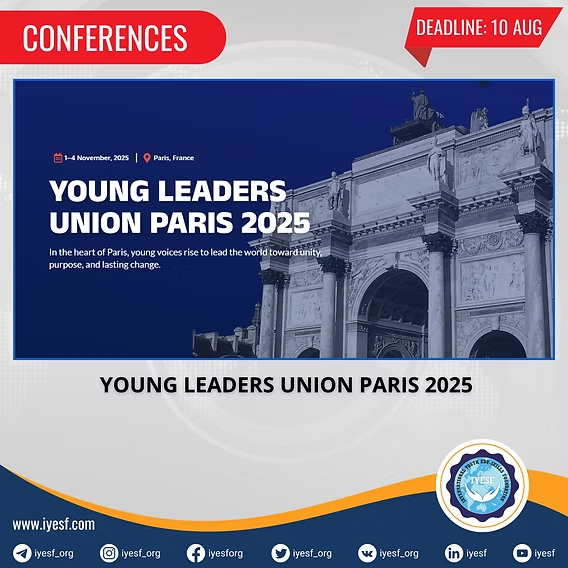
Young Leaders Union Conference 2025 in Paris (Fully Funded)
Join Global Changemakers in Paris! Fully Funded International Conference for Students, Professionals, and Social Leaders from All Nationalities and Fields

Yer yürəsinin daxili nüvəsində struktur dəyişiklikləri aşkar edilib
bu nəzəriyyənin doğru olmadığı məlum olub. Seismik dalğalar vasitəsilə aparılan tədqiqatda daxili nüvənin səthindəki dəyişikliklərə dair qeyri-adi məlumatlar əldə edilib.

Lester B Pearson Scholarship 2026 in Canada (Fully Funded)
Applications are now open for the Lester B Pearson Scholarship 2026 at the University of Toronto!