
Applying to KAUST - Your Complete Guide for Masters & Ph.D. Programs (Upcoming Admissions)
Admissions Overview & Key Requirements


A quarter of teenagers in England and Wales have sought mental health support from AI chatbots over the past year, according to new research from the Youth Endowment Fund (YEF) — sparking serious concerns about whether artificial intelligence is a safe or adequate replacement for professional care.
The figures emerge from a survey of close to 11,000 young people between the ages of 13 and 17, conducted as part of the YEF's annual Children, Violence and Vulnerability report. Roughly half of all teenagers surveyed had sought some form of online mental health assistance in the previous twelve months, with one in four specifically choosing AI chatbots as their outlet.
Violence-affected teens rely on AI at far higher rates
Young people with direct exposure to serious violence — whether as victims or those who had carried it out — were significantly more likely to look for help online. Nearly nine in ten had done so, a rate almost double that of teenagers with no such experience. The reliance on AI chatbots was similarly elevated: well over a third of victims and approaching half of those who had perpetrated serious violence had turned to chatbots for support, compared to roughly one in five among those untouched by violence.
The report also found that AI chatbots were consulted more frequently than other established digital resources, including dedicated mental health websites, peer support forums, and wellbeing apps.
A generation under serious mental health strain
Approximately one in four teenagers across England and Wales showed signs of significant mental health difficulties — a figure that translates to close to a million young people nationally. A quarter carried a formal diagnosis of a mental health or neurodevelopmental condition, while a further one in five believed they had an undiagnosed condition, suggesting a large portion of struggling young people remain without consistent support.
The intersection of violence and mental health was particularly stark. Young people caught up in serious violence on either side were roughly five times more likely to have harmed themselves or experienced thoughts of suicide than peers with no such exposure. Diagnosed conditions were also dramatically more prevalent among this group — with rates among victims and perpetrators running at around four times those seen in teenagers with no history of violence.
Experts warn: young people need humans, not bots
Jon Yates, chief executive of the Youth Endowment Fund, said the scale of unmet need made it unsurprising that young people were gravitating toward technology, but stressed that this was no substitute for genuine human support. He argued that for young people affected by violence in particular, having a trusted adult who listens and offers reassurance could be transformative in ways no chatbot can replicate.
Ajada, a member of the YEF's Youth Advisory Board, raised concern about what is lost when teenagers in crisis turn to AI. She pointed out that while a chatbot may hand over information, it cannot take responsibility for how a vulnerable young person acts on it — and that this gap represents the loss of something vital that comes only through real human connection.
These concerns align with a broader health warning issued earlier this year, in which the NHS cautioned young people against substituting AI chatbots for professional therapy, citing the risk of harmful and misleading advice.
Support that works
The YEF highlights several approaches with solid evidence behind them, including trauma-focused therapy, Cognitive Behavioural Therapy, Functional Family Therapy, and Multi-Systemic Therapy. Structured activities such as sports and arts programmes are also recognised for helping young people build confidence, manage emotions, and develop relationships with trusted adults.
Yet access to formal support remains deeply inadequate. Only around a third of those with a confirmed diagnosis and fewer than one in five with a suspected condition were receiving any professional help at the time of the survey.
Share
Applying to KAUST - Your Complete Guide for Masters & Ph.D. Programs (Upcoming Admissions)
Admissions Overview & Key Requirements

An mRNA cancer vaccine may offer long-term protection
A small clinical trial suggests the treatment could help keep pancreatic cancer from returning

Registration Opens for SAF 2025: International STEAM Azerbaijan Festival Welcomes Global Youth
The International STEAM Azerbaijan Festival (SAF) has officially opened registration for its 2025 edition!
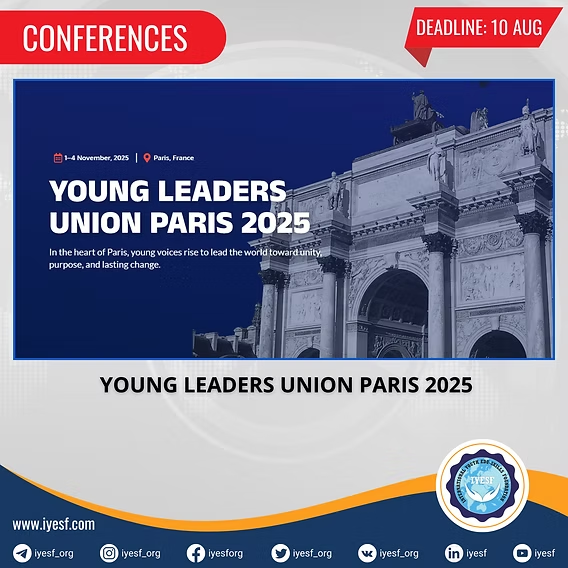
Young Leaders Union Conference 2025 in Paris (Fully Funded)
Join Global Changemakers in Paris! Fully Funded International Conference for Students, Professionals, and Social Leaders from All Nationalities and Fields

Yer yürəsinin daxili nüvəsində struktur dəyişiklikləri aşkar edilib
bu nəzəriyyənin doğru olmadığı məlum olub. Seismik dalğalar vasitəsilə aparılan tədqiqatda daxili nüvənin səthindəki dəyişikliklərə dair qeyri-adi məlumatlar əldə edilib.

Lester B Pearson Scholarship 2026 in Canada (Fully Funded)
Applications are now open for the Lester B Pearson Scholarship 2026 at the University of Toronto!