
Applying to KAUST - Your Complete Guide for Masters & Ph.D. Programs (Upcoming Admissions)
Admissions Overview & Key Requirements

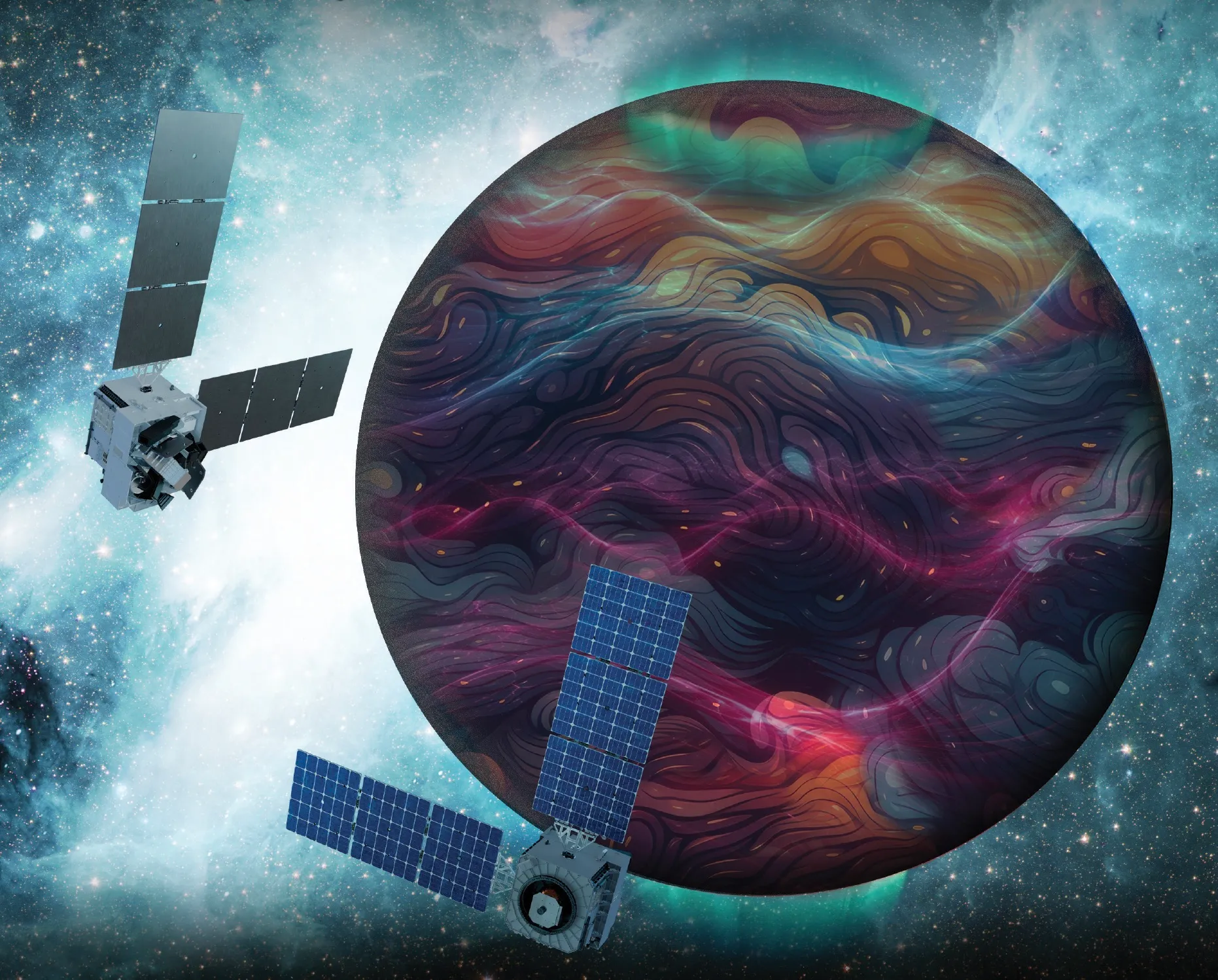
Artist’s rendition of the DAPHNE (Dynamic Atmosphere-Ionosphere Explorer) mission concept. The coloring represents auroras and atmospheric waves in Earth’s atmosphere File: NASA
The mission, officially known as Dynamic Atmosphere-Ionosphere Explorer (DAPHNE), will move into the next stage of development, where scientists will begin detailed planning and design work. The project will use two identical satellites to examine how activity in the lower atmosphere influences the upper atmosphere, where space weather events occur.
According to NASA, the mission will help improve predictions of space weather, which can affect important technologies such as GPS systems, low Earth orbit satellites, and communications. Better forecasting could also help protect astronauts during future space missions.
"By providing new insights into Earth's atmosphere, we can better predict and prepare for impacts in our daily lives on Earth and in space," said Nicky Fox, associate administrator of NASA's Science Mission Directorate.
The twin satellites will collect data on winds, temperature, and atmospheric composition in the thermosphere, a region where Earth's atmosphere gradually transitions into space. Scientists hope these observations will improve understanding of how energy from the lower atmosphere influences conditions in near-Earth space.
The mission is led by Aimee Merkel of the Laboratory for Atmospheric and Space Physics at the University of Colorado Boulder.
DAPHNE is scheduled for a confirmation review in 2027. If approved, the mission's cost, excluding launch expenses, will be capped at $250 million. The earliest possible launch date is 2029.
The mission was proposed under NASA's DYNAMIC program, which focuses on understanding interactions between Earth's atmosphere and the space environment.
Share
Applying to KAUST - Your Complete Guide for Masters & Ph.D. Programs (Upcoming Admissions)
Admissions Overview & Key Requirements

An mRNA cancer vaccine may offer long-term protection
A small clinical trial suggests the treatment could help keep pancreatic cancer from returning

Registration Opens for SAF 2025: International STEAM Azerbaijan Festival Welcomes Global Youth
The International STEAM Azerbaijan Festival (SAF) has officially opened registration for its 2025 edition!
Young Leaders Union Conference 2025 in Paris (Fully Funded)
Join Global Changemakers in Paris! Fully Funded International Conference for Students, Professionals, and Social Leaders from All Nationalities and Fields

Yer yürəsinin daxili nüvəsində struktur dəyişiklikləri aşkar edilib
bu nəzəriyyənin doğru olmadığı məlum olub. Seismik dalğalar vasitəsilə aparılan tədqiqatda daxili nüvənin səthindəki dəyişikliklərə dair qeyri-adi məlumatlar əldə edilib.

Lester B Pearson Scholarship 2026 in Canada (Fully Funded)
Applications are now open for the Lester B Pearson Scholarship 2026 at the University of Toronto!