
Applying to KAUST - Your Complete Guide for Masters & Ph.D. Programs (Upcoming Admissions)
Admissions Overview & Key Requirements

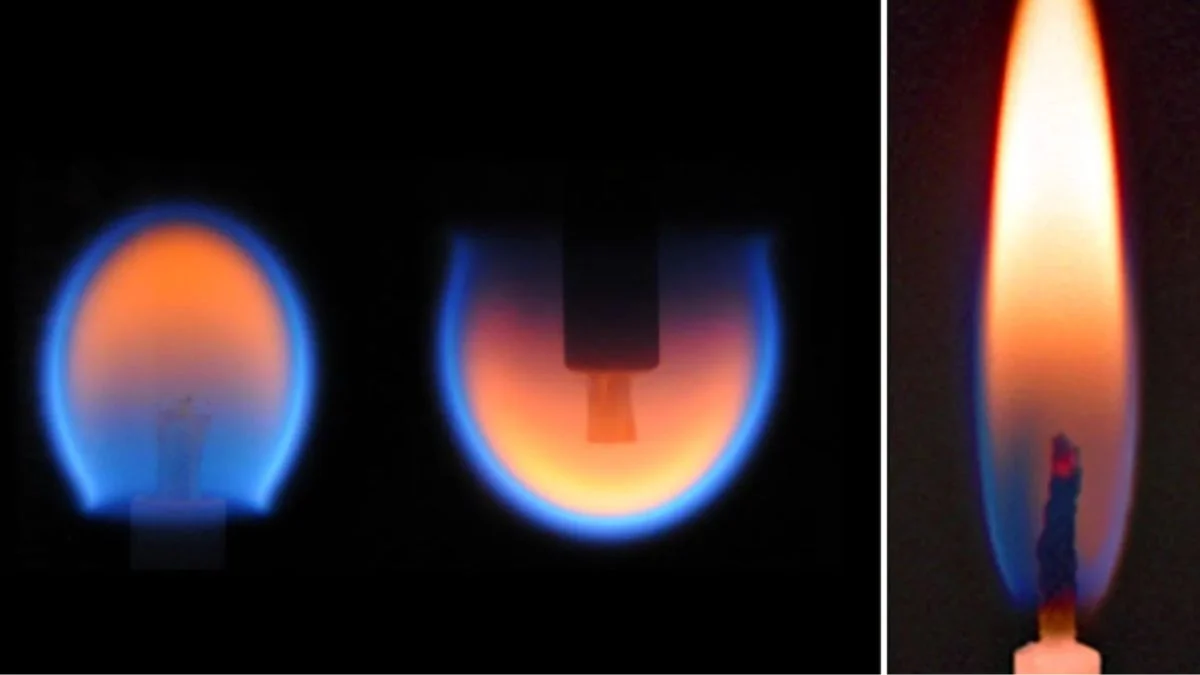
A spherical flame created in space (left), and a candle flame burning on Earth (right)/ File: NASA
According do Science Alert, fire remains one of the most serious risks for upcoming crewed space missions, and understanding how flames behave in different gravitational environments has become a top priority for scientists. A new study conducted by researchers from NASA Glenn Research Center, NASA Johnson Space Center, and Case Western Reserve University outlines plans to investigate flammability directly on the lunar surface.
On Earth, gravity causes hot gases from a flame to rise, drawing in cooler oxygen at the base. This process can sometimes extinguish flames through a phenomenon known as “blowoff.” However, on the Moon, where gravity is much weaker, this airflow is significantly slower. As a result, oxygen can continuously feed a flame without triggering blowoff, meaning materials that are only marginally flammable on Earth could burn longer and more steadily in lunar conditions.
For decades, NASA has relied on the NASA-STD-6001B to evaluate how materials burn. This test involves exposing a vertically mounted sample to a flame and measuring how far combustion spreads. While effective on Earth, it does not fully capture the complexities of fire behavior in space environments.
In microgravity conditions, such as aboard the International Space Station, flames do not rise but instead form slow-moving, spherical shapes. Their behavior is heavily influenced by ventilation systems, which supply oxygen. Previous experiments have shown that simply removing airflow may not extinguish a fire but could instead allow materials to smolder and reignite later.
To address these gaps, NASA previously conducted the Saffire experiment, which studied large-scale fires in uncrewed spacecraft. These tests revealed unexpected behaviors, including flames spreading against airflow and burning more intensely on thinner materials.
Building on these findings, the upcoming “Flammability of Materials on the Moon” (FM2) experiment will be deployed through the Commercial Lunar Payload Services initiative. The experiment will involve igniting solid material samples inside a sealed chamber on the Moon’s surface, equipped with cameras, oxygen sensors, and radiometers.
Unlike short-duration tests conducted in drop towers or parabolic flights, FM2 will allow scientists to observe fire behavior in lunar gravity for several minutes. This extended observation period is expected to provide critical insights into combustion dynamics in low-gravity environments.
The results could play a key role in updating safety standards and preventing fire hazards in future lunar habitats, as agencies prepare for long-term human missions beyond Earth.
Share
Applying to KAUST - Your Complete Guide for Masters & Ph.D. Programs (Upcoming Admissions)
Admissions Overview & Key Requirements

An mRNA cancer vaccine may offer long-term protection
A small clinical trial suggests the treatment could help keep pancreatic cancer from returning

Registration Opens for SAF 2025: International STEAM Azerbaijan Festival Welcomes Global Youth
The International STEAM Azerbaijan Festival (SAF) has officially opened registration for its 2025 edition!
Young Leaders Union Conference 2025 in Paris (Fully Funded)
Join Global Changemakers in Paris! Fully Funded International Conference for Students, Professionals, and Social Leaders from All Nationalities and Fields

Yer yürəsinin daxili nüvəsində struktur dəyişiklikləri aşkar edilib
bu nəzəriyyənin doğru olmadığı məlum olub. Seismik dalğalar vasitəsilə aparılan tədqiqatda daxili nüvənin səthindəki dəyişikliklərə dair qeyri-adi məlumatlar əldə edilib.

Lester B Pearson Scholarship 2026 in Canada (Fully Funded)
Applications are now open for the Lester B Pearson Scholarship 2026 at the University of Toronto!