Applying to KAUST - Your Complete Guide for Masters & Ph.D. Programs (Upcoming Admissions)
Admissions Overview & Key Requirements

Image from i-Tech Support
There is a significant discourse related to negative and positive effects of AI on education. According to a report by Center of Universal Education at Brookings, there are several advantages and shortcomings of AI use in schools and universities.
The first benefit could be AI handling repetitive and routine tasks. This can have positive effect on teachers since their workload would be decreased. Teachers can treat AI as a personal assistant. Most AI tools can handle tasks like lesson planning, creating assessment design and grading procedures. Artificial Intelligence can complete a lot of administrative tasks. In such case, AI can act as a productivity tool and have positive effects on education systems.
But not only teachers benefit from integration of AI. Based on the report, students can learn several subjects better when AI is implemented. Research made by education and technology companies shows that AI made text-based learning can have positive effect on student in some cases. AI could provide more engaging and easily-explained explanations to many areas of study.
There are also significant disadvantages of AI use. The report states that AI can threaten trust in educational institutions. It can have negative impact on peer-to-peer and student-teacher relationships. For instance, instead of asking their classmate or teacher about something that they couldn't understand during the lesson, students would just ask AI chatbot about it. This results in strained relationships between students and teachers. Teachers would not trust students and their perceived abilities/knowledge anymore. Students would also stop communicating among each other.
AI also influences students' cognitive development in a negative way. In other words, if artificial intelligence is being used on a daily basis by students, they can start to struggle with their thinking processes' development or memory retention. They can face difficulties with developing critical thinking skills. To add more, everyday usage of AI by students results in cognitive offloading. Students simply delegate all the tasks that they need to complete to an artificial intelligence tool.
The topic of AI integration in education is a complex one and should be analyzed by educational institutions in order to make the best decisions.
Share
Applying to KAUST - Your Complete Guide for Masters & Ph.D. Programs (Upcoming Admissions)
Admissions Overview & Key Requirements

An mRNA cancer vaccine may offer long-term protection
A small clinical trial suggests the treatment could help keep pancreatic cancer from returning

Registration Opens for SAF 2025: International STEAM Azerbaijan Festival Welcomes Global Youth
The International STEAM Azerbaijan Festival (SAF) has officially opened registration for its 2025 edition!
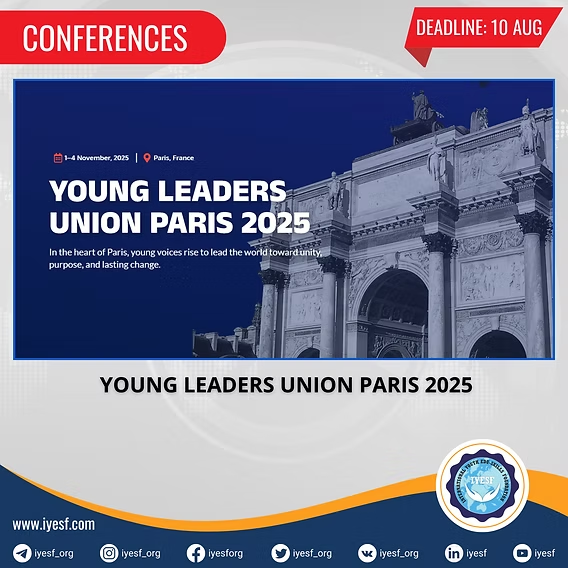
Young Leaders Union Conference 2025 in Paris (Fully Funded)
Join Global Changemakers in Paris! Fully Funded International Conference for Students, Professionals, and Social Leaders from All Nationalities and Fields

Yer yürəsinin daxili nüvəsində struktur dəyişiklikləri aşkar edilib
bu nəzəriyyənin doğru olmadığı məlum olub. Seismik dalğalar vasitəsilə aparılan tədqiqatda daxili nüvənin səthindəki dəyişikliklərə dair qeyri-adi məlumatlar əldə edilib.

Lester B Pearson Scholarship 2026 in Canada (Fully Funded)
Applications are now open for the Lester B Pearson Scholarship 2026 at the University of Toronto!