Applying to KAUST - Your Complete Guide for Masters & Ph.D. Programs (Upcoming Admissions)
Admissions Overview & Key Requirements


For some of us, books are a way to spend our free time productively; for others, they are decorative elements that make a home look more aesthetic. Neatly arranged books on shelves add a special spirit to an interior. But the true value of a book is not in its cover or how it looks on a shelf. In fact, books are among the most powerful tools that shape our way of thinking, broaden our worldview and enrich us internally.
Reading not only informs a person but also encourages critical thinking, analysis, comparison and understanding different perspectives. This means not only personal development but also a healthier future. In today’s fast-paced flow of information, maintaining focus has become increasingly difficult, yet reading acts as a kind of exercise for our brain.
A new study shows that reading, writing and learning one or two foreign languages may reduce the risk of dementia by approximately 40%. Researchers state that interacting with intellectually stimulating environments throughout life has a “strong impact” on cognitive health in older age.
Dementia is currently one of the world’s greatest health threats. It is projected that by 2050, the number of people living with the condition will triple to more than 150 million globally. Experts warn that this increase will create a serious burden on global healthcare and social service systems.
In a US-based study published in the journal Neurology, 1,939 participants with an average age of 80 who did not have dementia at the beginning of the research were followed for eight years. Participants completed surveys about reading, writing, language learning and other mental activities at different stages of their lives — childhood, midlife and older age.
According to the findings:
• Among those with the highest level of lifelong cognitive enrichment, 21% developed Alzheimer’s disease, compared with 34% among those with the lowest level.
• After accounting for age, sex and education, high mental activity reduced the risk of Alzheimer’s by 38% and mild cognitive impairment (MCI) by 36%.
• Individuals with the highest enrichment developed Alzheimer’s at an average age of 94, while those with the lowest levels developed it at 88 — a delay of more than five years.
The study’s lead author, Andrea Zammit of Rush University Medical Center in Chicago, noted that the findings demonstrate the strong impact of staying mentally active throughout life on cognitive health in older age. She added that public investment in libraries and early education programs that promote lifelong learning could help reduce dementia cases.
Dr. Isolde Radford of Alzheimer’s Research UK, who was not involved in the study, emphasized that the results show dementia is not an inevitable part of aging.
Although the study does not prove a direct cause-and-effect relationship, it shows a strong association and highlights the potential protective role of mental activity.
In today’s technology-driven era, lack of time is one of the most common excuses we make. However, even 20–30 minutes of reading per day can make a significant difference in the long term. Instead of waiting for the “perfect time” to read, making it a part of daily life is far more effective.
When was the last time you read a book? Are you waiting for your workload to decrease or your exams to end before you start reading? Perhaps the right time to begin is today.
February 14 — International Book Giving Day — promotes exactly this idea. The initiative was founded in 2012 by Amy Broadmoore, who aimed to share a love of books and support children who may not have easy access to them. The movement quickly gained international attention and turned into a global campaign joined by thousands of book lovers.
Since 2013, the organization of the day has been continued by children’s author Emma Perry, founder of “My Book Corner,” with the support of volunteers and children’s literature advocates.
International Book Giving Day brings together two essential values: a love of books and a love for people. It is not only about giving a book but also about promoting reading culture, sharing knowledge and making a small yet meaningful difference in someone’s life.
This February 14, consider giving a book to your closest friend, sibling or a child in need. Because a book is not just an object — it is the most valuable gift to the mind, memory and the future.
Share
Applying to KAUST - Your Complete Guide for Masters & Ph.D. Programs (Upcoming Admissions)
Admissions Overview & Key Requirements

An mRNA cancer vaccine may offer long-term protection
A small clinical trial suggests the treatment could help keep pancreatic cancer from returning

Registration Opens for SAF 2025: International STEAM Azerbaijan Festival Welcomes Global Youth
The International STEAM Azerbaijan Festival (SAF) has officially opened registration for its 2025 edition!
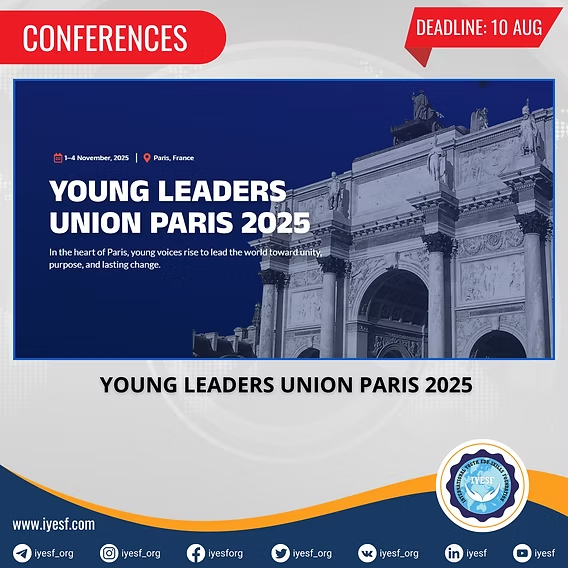
Young Leaders Union Conference 2025 in Paris (Fully Funded)
Join Global Changemakers in Paris! Fully Funded International Conference for Students, Professionals, and Social Leaders from All Nationalities and Fields

Yer yürəsinin daxili nüvəsində struktur dəyişiklikləri aşkar edilib
bu nəzəriyyənin doğru olmadığı məlum olub. Seismik dalğalar vasitəsilə aparılan tədqiqatda daxili nüvənin səthindəki dəyişikliklərə dair qeyri-adi məlumatlar əldə edilib.

Lester B Pearson Scholarship 2026 in Canada (Fully Funded)
Applications are now open for the Lester B Pearson Scholarship 2026 at the University of Toronto!