
Applying to KAUST - Your Complete Guide for Masters & Ph.D. Programs (Upcoming Admissions)
Admissions Overview & Key Requirements

According to the BBC, researchers have experimented with unusual techniques to test chatbot performance. Calling the AI “smart,” telling it to “think carefully,” or ending a question with a positive phrase like “This will be fun!” made little to no difference. However, one detail stood out: when AI was asked to imagine itself in the universe of Star Trek, it performed better on basic math problems.
Experts say that in earlier years, small wording tricks could sometimes make a difference by chance. Today, however, newer-generation models are much better at identifying the core meaning of a prompt. Minor wording changes no longer make them systematically “smarter.”
Does politeness help?
Research findings on politeness remain mixed. Some studies suggest that polite phrasing can slightly improve response quality. Other experiments have found the opposite — that harsher wording produced more accurate answers. Since AI models are constantly updated, such findings quickly become outdated.
The general consensus among experts is that politeness or rudeness does not consistently affect accuracy. Artificial intelligence is not human and does not respond emotionally — it simply processes input statistically.
What actually works?
Specialists recommend more practical approaches:
Don’t settle for a single answer.
Ask for multiple options instead of just one. For example, request three different writing styles. This broadens your choices and encourages critical thinking.
Provide examples.
If you ask AI to draft an email, sharing samples of your previous writing is often more effective than giving long instructions. Saying “Use this style” works better than listing multiple do’s and don’ts.
Use a question-based format.
When creating something like a job description, ask the AI to question you step by step before generating the final result. This usually leads to more accurate and tailored outputs.
Be cautious with role-playing.
Assigning AI the role of a “math professor” or “experienced lawyer” may sometimes make it overly confident and increase the risk of incorrect information. However, role-playing can be useful for brainstorming and creative tasks.
Stay neutral.
If you are deciding between two options, avoid revealing your preference in advance. Otherwise, the model is likely to generate an answer aligned with your stated inclination.
Treat it like a tool
Experts emphasize that AI should be approached as a tool, not as a being with moods or emotions. Instead of trying to persuade, flatter, or intimidate it, present your task clearly and in a structured way.
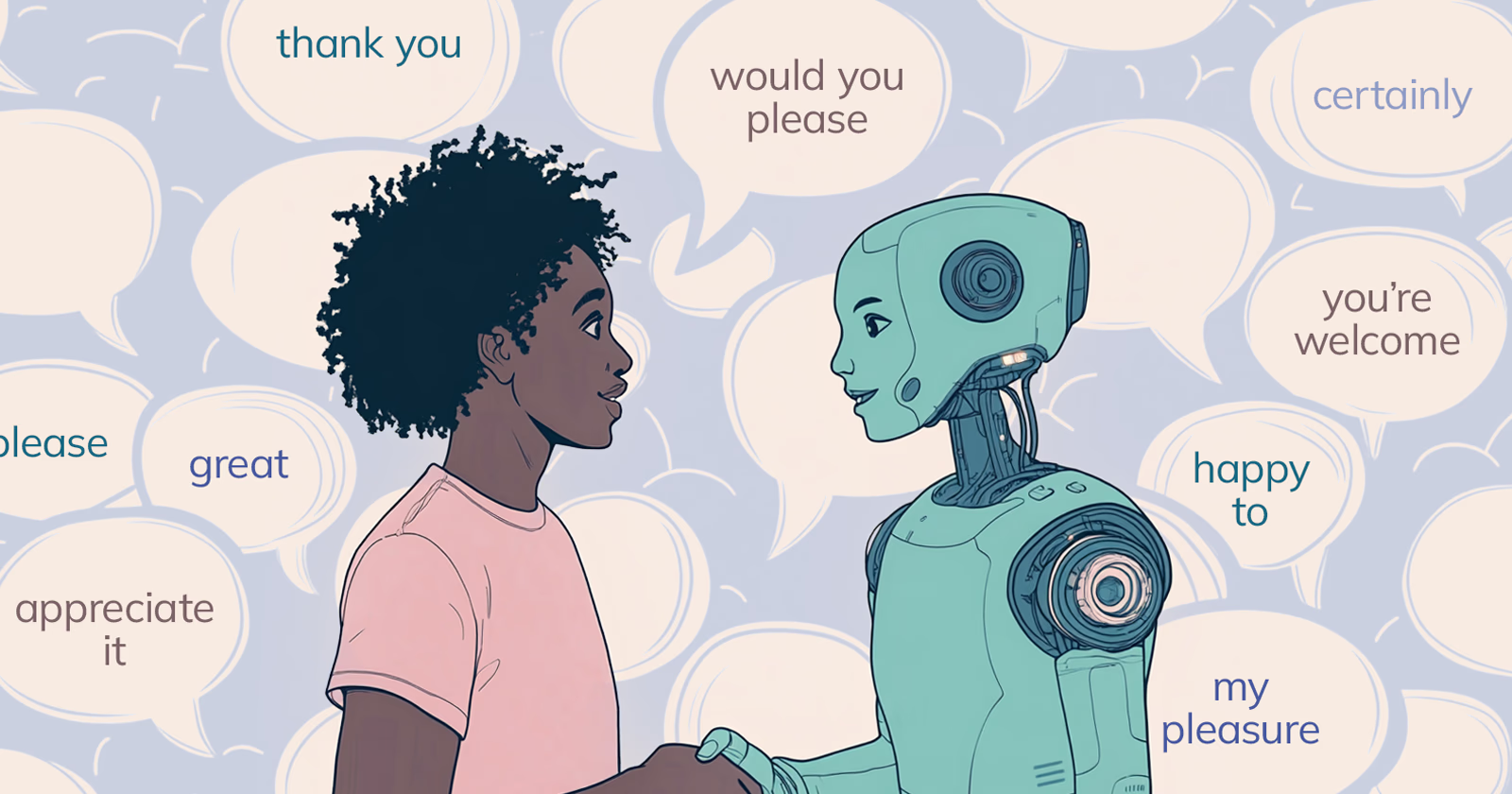
That said, politeness remains a personal choice. Surveys show that many users continue to say “please” when interacting with AI. While this may not improve performance, it can make people feel more comfortable during the interaction.
Ultimately, rather than searching for “magic words,” clarity, specificity, and structure are the most powerful tools. The key to effective communication with artificial intelligence lies not in emotion, but in how you frame your request.
Share
Applying to KAUST - Your Complete Guide for Masters & Ph.D. Programs (Upcoming Admissions)
Admissions Overview & Key Requirements

An mRNA cancer vaccine may offer long-term protection
A small clinical trial suggests the treatment could help keep pancreatic cancer from returning

Registration Opens for SAF 2025: International STEAM Azerbaijan Festival Welcomes Global Youth
The International STEAM Azerbaijan Festival (SAF) has officially opened registration for its 2025 edition!
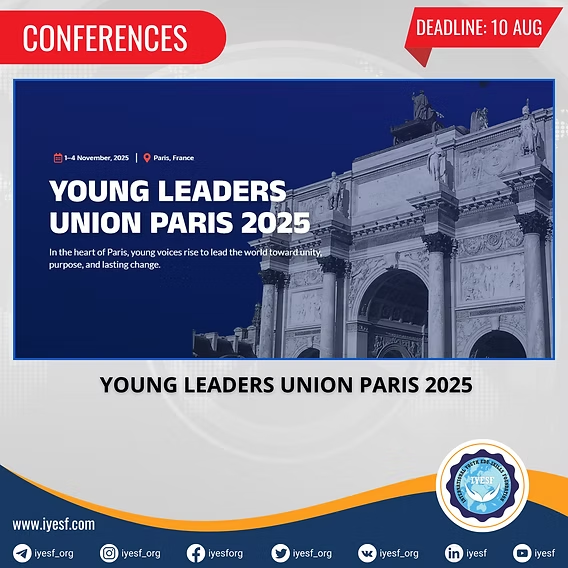
Young Leaders Union Conference 2025 in Paris (Fully Funded)
Join Global Changemakers in Paris! Fully Funded International Conference for Students, Professionals, and Social Leaders from All Nationalities and Fields

Yer yürəsinin daxili nüvəsində struktur dəyişiklikləri aşkar edilib
bu nəzəriyyənin doğru olmadığı məlum olub. Seismik dalğalar vasitəsilə aparılan tədqiqatda daxili nüvənin səthindəki dəyişikliklərə dair qeyri-adi məlumatlar əldə edilib.

Lester B Pearson Scholarship 2026 in Canada (Fully Funded)
Applications are now open for the Lester B Pearson Scholarship 2026 at the University of Toronto!