Applying to KAUST - Your Complete Guide for Masters & Ph.D. Programs (Upcoming Admissions)
Admissions Overview & Key Requirements


File: New Horizons Education
The average length of schooling in Türkiye has increased to 9.6 years, while the proportion of university graduates among young adults aged 25–34 has reached 45.6%, according to the latest national education statistics released by the Turkish Statistical Institute (TÜİK).
The data show significant progress in educational attainment over the past two decades. In 2008, only 13.5% of people aged 25–34 had completed higher education. By 2025, this figure had risen to 45.6%. Among women in the same age group, the share of higher education graduates increased from 12.5% to 50.3%, while the rate among men rose from 14.6% to 41%.
Comparing Türkiye with members of the Organisation for Economic Co-operation and Development (OECD), the latest available 2024 figures indicate that the OECD average for higher education attainment among 25–34-year-olds was 48.7%, while Türkiye recorded 44.9%. South Korea had the highest rate at 70.6%, while Mexico recorded the lowest at 29.1%.
Among the population aged 25 and over, the proportion of associate, bachelor’s, master’s and doctoral degree holders increased from 9.8% in 2008 to 26.1% in 2025. The share of individuals with at least a secondary education rose from 26.5% to 50.5% during the same period. The average years of schooling for people aged 25 and above reached 9.6 years in 2025. Women averaged 8.9 years of education, while men averaged 10.3 years.
Ankara recorded the highest average education duration among provinces, with 10.9 years of schooling, followed by Istanbul, Eskishehir, Kojaeli and Yalova. Aghri had the lowest average at 7.6 years, followed by Shanliurfa, Mush, Kastamonu and Van.
Between 2016 and 2025, the largest increases in average years of schooling were recorded in Shirnak (48.5%), Hakkari (40.4%), Mush (35.7%), Shanliurfa (35.5%) and Van (33.1%). The smallest increases were observed in Ankara (13.2%), Eskishehir (14.5%), Tekirdagh (14.6%), İzmir (14.8%) and Istanbul (15.1%). Literacy rates also improved significantly. The proportion of literate people aged six and above increased from 91.8% in 2008 to 97.9% in 2025. During this period, literacy among women rose from 86.9% to 96.4%, while among men it increased from 96.7% to 99.3%.
The report also highlighted a strong link between parents’ education levels and educational outcomes. Among adults aged 25 and over whose mothers had completed higher education, 84.2% also obtained a higher education degree. For those whose fathers were higher education graduates, the corresponding figure was 80.4%.
Furthermore, 64.3% of individuals whose mothers completed secondary education and 56% of those whose fathers completed secondary education went on to earn higher education qualifications. Among individuals whose parents had education levels below secondary school, around 29% still managed to complete higher education. The findings indicate steady progress in Türkiye’s educational development, with rising literacy rates, longer average schooling periods, and a growing share of university graduates across the country.
Share
Applying to KAUST - Your Complete Guide for Masters & Ph.D. Programs (Upcoming Admissions)
Admissions Overview & Key Requirements

An mRNA cancer vaccine may offer long-term protection
A small clinical trial suggests the treatment could help keep pancreatic cancer from returning

Registration Opens for SAF 2025: International STEAM Azerbaijan Festival Welcomes Global Youth
The International STEAM Azerbaijan Festival (SAF) has officially opened registration for its 2025 edition!
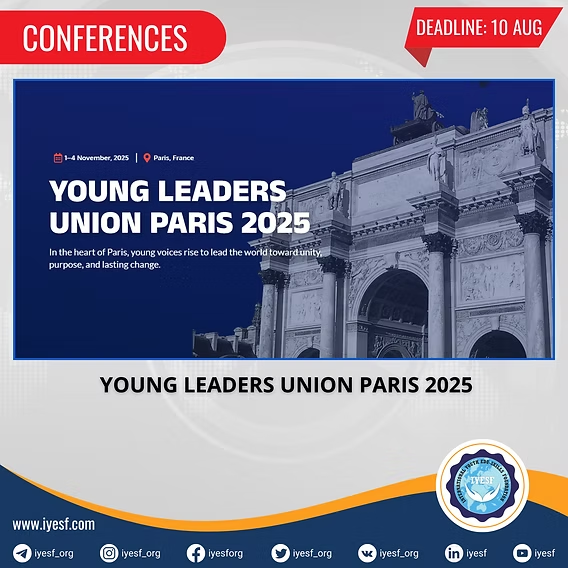
Young Leaders Union Conference 2025 in Paris (Fully Funded)
Join Global Changemakers in Paris! Fully Funded International Conference for Students, Professionals, and Social Leaders from All Nationalities and Fields

Yer yürəsinin daxili nüvəsində struktur dəyişiklikləri aşkar edilib
bu nəzəriyyənin doğru olmadığı məlum olub. Seismik dalğalar vasitəsilə aparılan tədqiqatda daxili nüvənin səthindəki dəyişikliklərə dair qeyri-adi məlumatlar əldə edilib.

Lester B Pearson Scholarship 2026 in Canada (Fully Funded)
Applications are now open for the Lester B Pearson Scholarship 2026 at the University of Toronto!