Applying to KAUST - Your Complete Guide for Masters & Ph.D. Programs (Upcoming Admissions)
Admissions Overview & Key Requirements

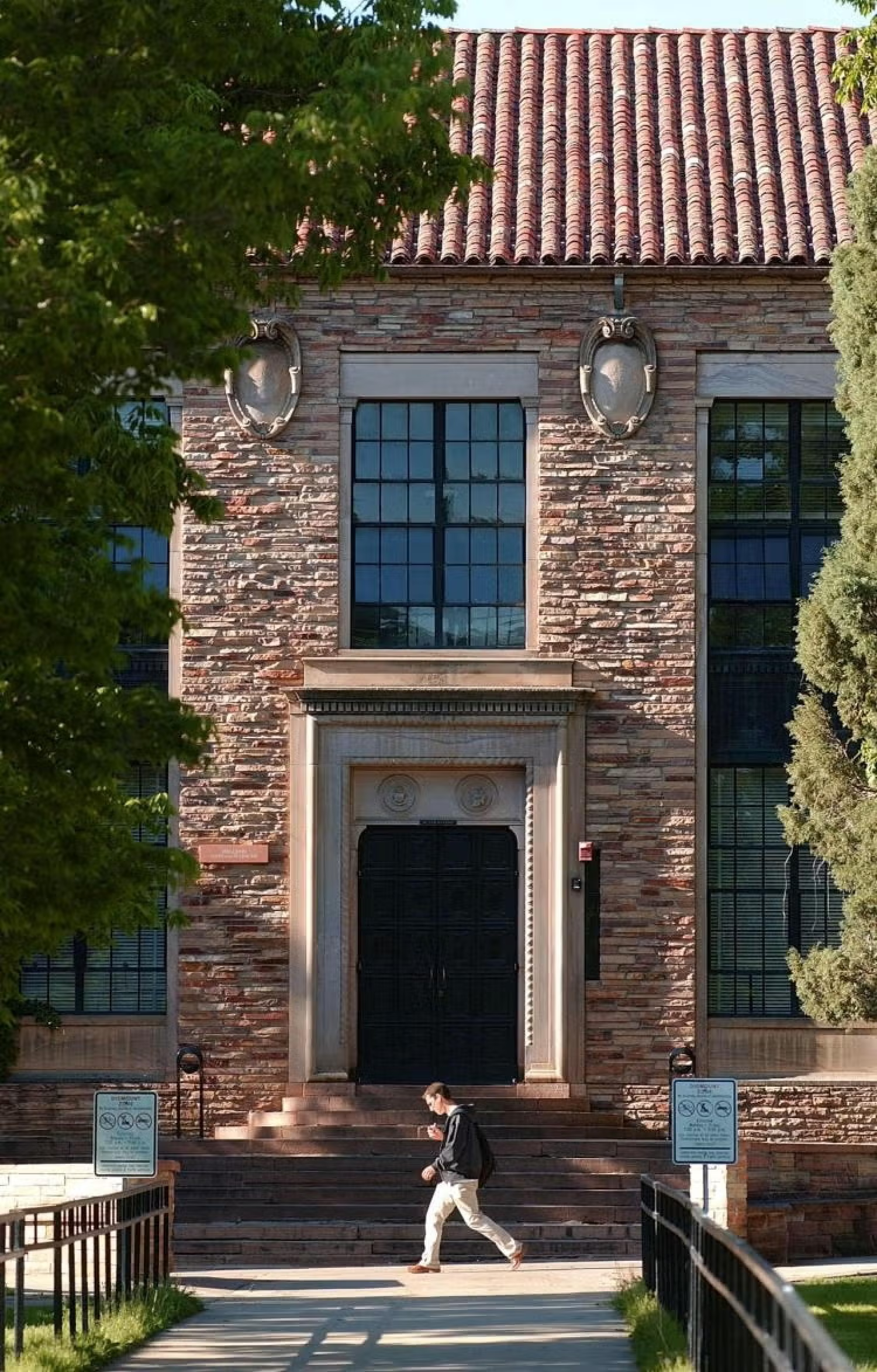
Person/ File: Colorado arts and science magazine
According to Colorado arts and science magazine, in 1921, the world was emerging from a devastating pandemic. In the United States, isolationist attitudes were strong, immigration was viewed with suspicion, and society was deeply divided along racial lines. Economic instability also led many to question whether a traditional liberal arts education was truly worthwhile.
History may not repeat itself exactly, but it often echoes familiar patterns.
This month, 105 years after Hellems first opened, officials at CU Boulder marked the completion of its renovation. They celebrated the building as a central hub of campus life-a shared space that connects students and continues to house essential disciplines within the humanities.
Today, we again find ourselves in the aftermath of a pandemic, amid growing isolationism and intense debates over immigration, race, and the value of a liberal arts education.
To understand this conversation, it helps to clarify what “liberal arts” actually means. The term can be misleading in modern contexts. For the ancient Greeks and Romans, a well-rounded education was essential for preparing citizens to participate in democracy.
Cicero argued that individuals who wish to contribute meaningfully to society must develop a broad set of skills. He referred to these as the artes liberales-the “arts of free people.” These included rhetoric, literature, poetry, ethics, civics, logic, geometry, music, astronomy, and natural science.
In essence, he was describing a comprehensive education in both the arts and sciences.
While the scope of the liberal arts has expanded over the past two millennia, the core idea remains the same: these disciplines equip individuals to engage thoughtfully in civic life and the broader world.
At CU Boulder today, the College of Arts and Sciences continues to place the liberal arts at the center of education. Still, many students and families question whether such degrees offer a strong financial return.
It is true that graduates in fields like engineering and business often earn higher salaries at the start of their careers. However, those with liberal arts degrees frequently experience significant income growth later on, sometimes matching their peers in technical fields.
Financial outcomes matter, but they are only part of the picture-and this debate is not new.
When Hellems opened in 1921, university president George Norlin also defended liberal education against its critics. Among them was Henry Ford, who famously dismissed history as “more or less bunk.”
Norlin argued that focusing only on the present confines a person, limiting their ability to fully engage in life and society. He described liberal education as a force that “breaks down the walls of a prison,” expanding our understanding of the present into something richer and more meaningful.
He rejected the idea that universities should simply serve as job-training centers. Instead, he insisted their primary role is to sustain and advance civilization across generations.
Echoing Cicero, Norlin expressed the idea that anyone who knows only their own era remains intellectually immature.
Today, Hellems continues to house disciplines such as history, philosophy, English, and linguistics, along with language and cultural programs.
CU Boulder Chancellor Justin Schwartz recently described the building as a place where ideas take shape, perspectives are challenged, and intellectual confidence begins to grow.
The work done there centers on essential questions:
How can we apply lessons from the past to shape the future?
How can we build understanding across cultures and languages?
How can we think clearly about truth, ethics, and responsibility?
These questions are more urgent than ever.
A century ago, society needed informed and thoughtful citizens. In a world of rapid change, that need has only intensified. By drawing on the wisdom of the past, we can better navigate the challenges of the future.
Share
Applying to KAUST - Your Complete Guide for Masters & Ph.D. Programs (Upcoming Admissions)
Admissions Overview & Key Requirements

An mRNA cancer vaccine may offer long-term protection
A small clinical trial suggests the treatment could help keep pancreatic cancer from returning

Registration Opens for SAF 2025: International STEAM Azerbaijan Festival Welcomes Global Youth
The International STEAM Azerbaijan Festival (SAF) has officially opened registration for its 2025 edition!
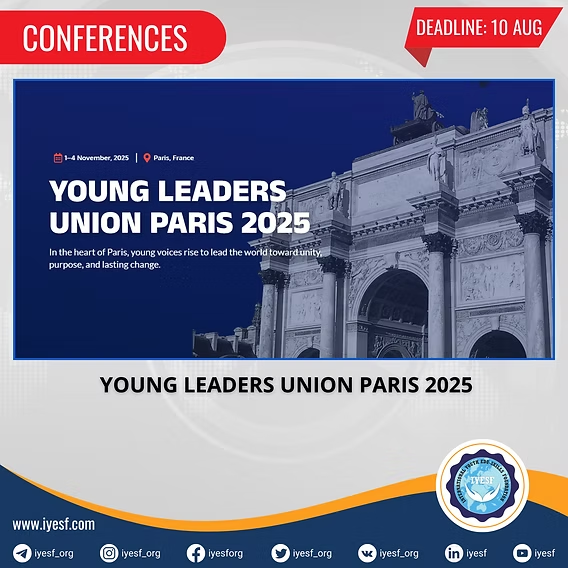
Young Leaders Union Conference 2025 in Paris (Fully Funded)
Join Global Changemakers in Paris! Fully Funded International Conference for Students, Professionals, and Social Leaders from All Nationalities and Fields

Yer yürəsinin daxili nüvəsində struktur dəyişiklikləri aşkar edilib
bu nəzəriyyənin doğru olmadığı məlum olub. Seismik dalğalar vasitəsilə aparılan tədqiqatda daxili nüvənin səthindəki dəyişikliklərə dair qeyri-adi məlumatlar əldə edilib.

Lester B Pearson Scholarship 2026 in Canada (Fully Funded)
Applications are now open for the Lester B Pearson Scholarship 2026 at the University of Toronto!