
Applying to KAUST - Your Complete Guide for Masters & Ph.D. Programs (Upcoming Admissions)
Admissions Overview & Key Requirements

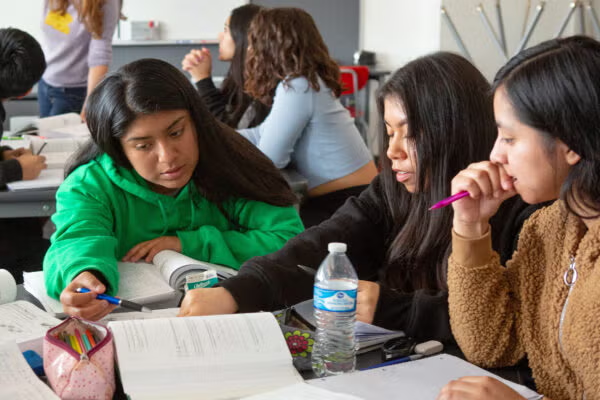
People/ File: FuturEd
According to FuturEd, student performance across the United States is in serious decline. Test scores have been falling in most states for years, and many students struggle with basic skills. By the end of middle school, about one in three students cannot read proficiently, and nearly a quarter miss school frequently.
Addressing this crisis requires strengthening public education, where the vast majority of American children are taught. For decades, improving schools was a bipartisan priority. Republicans played a major role in reform efforts as recently as the George W. Bush era, and some conservative-led states-such as Mississippi, Louisiana, and Tennessee-have made notable gains by focusing on clear standards, strong curricula, teacher support, and accountability.
However, these successes are not the norm. Today, many Republican leaders are more focused on cultural and political battles than on improving school quality. The Trump administration has largely avoided discussions about student achievement, instead pursuing policies aimed at weakening the Department of Education and expanding public funding for private schooling.
This creates an opening for Democrats to take the lead on education and reconnect with key voter groups who care deeply about schools. Yet Democrats themselves are divided.
Moderate Democrats tend to support standards, testing, accountability systems, charter schools, and school choice within public education. Progressive Democrats and teachers’ unions, on the other hand, often emphasize increased funding and addressing poverty as the main drivers of student success. These groups rarely find common ground, and their disagreements have weakened public confidence in the party’s ability to improve education.
Despite their differences, both sides offer valuable ideas. A successful strategy would combine their approaches-strengthening schools while also addressing the external challenges students face.
One area of agreement could be expanding school choice within the public system. While Republicans have promoted private school vouchers, these programs often lack accountability and primarily benefit wealthier families. Democrats could respond by supporting high-quality public options such as charter schools, magnet programs, and open enrollment systems, ensuring broader access and stronger oversight.
Another priority should be improving foundational skills. Research shows that effective reading instruction should focus on phonics and structured learning, while math education should balance conceptual understanding with practice and memorization. Promoting these proven methods could significantly boost student outcomes.
Democrats could also expand access to advanced coursework. Many high-achieving students-especially those from low-income backgrounds-lack opportunities to participate in gifted and advanced programs. A more inclusive system would identify talent in multiple ways and provide more students with challenging academic pathways.
In addition, creating a national tutoring initiative could help students who are falling behind. Tutoring has proven highly effective, but it has historically been available mostly to families who can afford it. Expanding access through public programs would support a much wider range of learners.
Reforming how schools are evaluated is another key step. Systems that rely heavily on standardized test scores often fail to capture the full picture of a school’s performance. A better approach would consider student progress over time, school environment, and other factors that influence learning.
Finally, strengthening partnerships between schools and community services could help address the non-academic challenges students face. Collaborations with healthcare providers, social services, and community organizations can improve attendance, well-being, and overall academic success.
In the past, major education reforms were achieved through cooperation between political parties and within them. While those efforts were not perfect, they did lead to improvements in student achievement. Today, with federal leadership on education weakened, Democrats have an opportunity to unite their internal factions, combine their ideas, and develop a comprehensive plan to improve public education and regain public trust.
Share
Applying to KAUST - Your Complete Guide for Masters & Ph.D. Programs (Upcoming Admissions)
Admissions Overview & Key Requirements

An mRNA cancer vaccine may offer long-term protection
A small clinical trial suggests the treatment could help keep pancreatic cancer from returning

Registration Opens for SAF 2025: International STEAM Azerbaijan Festival Welcomes Global Youth
The International STEAM Azerbaijan Festival (SAF) has officially opened registration for its 2025 edition!

Young Leaders Union Conference 2025 in Paris (Fully Funded)
Join Global Changemakers in Paris! Fully Funded International Conference for Students, Professionals, and Social Leaders from All Nationalities and Fields

Yer yürəsinin daxili nüvəsində struktur dəyişiklikləri aşkar edilib
bu nəzəriyyənin doğru olmadığı məlum olub. Seismik dalğalar vasitəsilə aparılan tədqiqatda daxili nüvənin səthindəki dəyişikliklərə dair qeyri-adi məlumatlar əldə edilib.

Lester B Pearson Scholarship 2026 in Canada (Fully Funded)
Applications are now open for the Lester B Pearson Scholarship 2026 at the University of Toronto!