
Applying to KAUST - Your Complete Guide for Masters & Ph.D. Programs (Upcoming Admissions)
Admissions Overview & Key Requirements


File: School Week
A survey conducted among school leaders shows that 51% of educational institutions in England have buildings or areas that are either out of use or considered unsuitable for teaching. Most respondents in a survey of members of the National Association of Headteachers (NAHT) said that the funding allocated for maintaining school buildings is insufficient, Schools Week reports.
According to the survey, around two-thirds of leaders reported that their school toilets are in poor condition. In addition, 76% of respondents said basic infrastructure such as windows, roofs, and doors is not up to standard. More than half of school leaders said playgrounds and classrooms are also unsuitable for use. Seven percent reported that some buildings and mobile classrooms are completely closed.
The survey also highlighted serious issues in special educational needs and disabilities (SEND) facilities, with 41% of respondents saying these spaces are unsuitable and 3% saying they are closed. NAHT general secretary Paul Whiteman described the situation as “incredible,” saying some schools are operating in old and even unsafe buildings. He added that some schools are forced to teach in buildings that are neither warm nor watertight.
Some school leaders taking part in the survey reported serious building problems, including leaking roofs, mould on walls, and rooms taken out of use. They also said the current situation forces them to choose between essential education spending and building repairs. In their view, this creates a dilemma of “books versus pipes.” Officials also emphasized that there is a serious lack of funding for school infrastructure and that additional investment is needed to improve the situation.
Share
Applying to KAUST - Your Complete Guide for Masters & Ph.D. Programs (Upcoming Admissions)
Admissions Overview & Key Requirements

An mRNA cancer vaccine may offer long-term protection
A small clinical trial suggests the treatment could help keep pancreatic cancer from returning

Registration Opens for SAF 2025: International STEAM Azerbaijan Festival Welcomes Global Youth
The International STEAM Azerbaijan Festival (SAF) has officially opened registration for its 2025 edition!
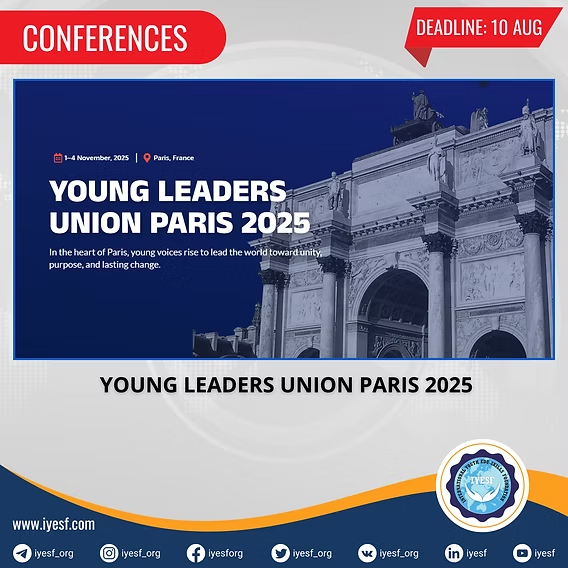
Young Leaders Union Conference 2025 in Paris (Fully Funded)
Join Global Changemakers in Paris! Fully Funded International Conference for Students, Professionals, and Social Leaders from All Nationalities and Fields

Yer yürəsinin daxili nüvəsində struktur dəyişiklikləri aşkar edilib
bu nəzəriyyənin doğru olmadığı məlum olub. Seismik dalğalar vasitəsilə aparılan tədqiqatda daxili nüvənin səthindəki dəyişikliklərə dair qeyri-adi məlumatlar əldə edilib.

Lester B Pearson Scholarship 2026 in Canada (Fully Funded)
Applications are now open for the Lester B Pearson Scholarship 2026 at the University of Toronto!