
Applying to KAUST - Your Complete Guide for Masters & Ph.D. Programs (Upcoming Admissions)
Admissions Overview & Key Requirements


File:FE Week
What makes Gaokao especially difficult is the enormous societal pressure attached to it. In China, admission to elite universities is seen as a pathway to financial security and social mobility. Many students begin preparing from a very young age, spending years attending extra tutoring classes and following intense study schedules. Families often invest heavily in their children’s education, while students sacrifice sleep, hobbies, and social life. Because university placements are highly competitive, even a small difference in scores can change a student’s future dramatically.
The exam consists of three stages: the Preliminary Exam, the Main Examination, and the Personality Test. The preliminary stage includes objective questions on general studies and aptitude. Candidates who pass move on to the written Main Exam, which contains nine papers covering subjects like history, geography, economics, politics, ethics, and optional specialization subjects. The final stage is a personal interview that assesses leadership, communication skills, confidence, and decision-making abilities.
The syllabus is extremely broad, requiring candidates to stay informed about current affairs while also mastering academic subjects. Preparation often takes years, and many aspirants dedicate their entire daily routine to studying. Despite millions applying every year, only a very small percentage secure top government posts, making UPSC one of the most selective exams globally.
The MBE consists of multiple-choice questions covering constitutional law, criminal law, contracts, evidence, and other core legal subjects. The MEE evaluates candidates’ ability to analyze legal problems through written essays, while the MPT tests practical legal skills using realistic case scenarios. The exam typically lasts two or three days and requires both legal knowledge and strong analytical thinking.
Preparation for the Bar Exam is intense. Candidates spend months memorizing laws, reviewing case studies, and practicing essays under timed conditions. In states like California, known for particularly difficult standards, pass rates are often below 50%. The pressure is especially high because passing the exam is essential for beginning a legal career.
Candidates are required to complete four extensive written papers. Two papers are based on their chosen academic discipline, while the remaining papers focus on general essays. Some essay prompts are famously abstract, consisting of a single word or phrase such as “freedom,” “chaos,” or “truth.” Applicants must produce highly original, deeply analytical responses supported by evidence and critical thinking.
What makes this exam unique is that it values creativity and intellectual originality more than memorization. The success rate is below 1%, and even brilliant students from Oxford struggle to pass. Winning the fellowship is considered one of academia’s highest achievements.
Level I tests foundational financial concepts and quantitative methods. Level II focuses on advanced valuation techniques and financial analysis, while Level III emphasizes portfolio management and practical investment decision-making. Each level requires candidates to study hundreds of hours, often while balancing full-time jobs.
One of the main reasons the CFA is so challenging is the sheer amount of material candidates must master. Ethics plays a major role throughout all three levels, and questions are designed to test practical understanding rather than simple memorization. Pass rates for each level are usually below 50%, and completing the entire qualification can take several years.
In the theory section, candidates must demonstrate extensive knowledge of wine regions, grape varieties, production methods, spirits, cigars, and global hospitality standards. The service section assesses practical restaurant skills, including wine pairing recommendations, bottle presentation, and handling demanding customer situations.
The most difficult part is often considered the blind tasting section. Candidates are required to identify wines purely through smell and taste, determining their origin, grape type, vintage, and production style with remarkable accuracy. Years of training and tasting experience are necessary to succeed. Because of its extremely low pass rate, becoming a Master Sommelier is considered one of the highest honors in the culinary and hospitality world.
USMLE Step 1 focuses on foundational sciences such as anatomy, pathology, and pharmacology. Step 2 assesses clinical knowledge and patient interaction skills, while Step 3 evaluates a doctor’s ability to manage real-world medical situations independently. The PLAB exam similarly combines theoretical questions with practical clinical examinations.
These exams are difficult because medicine requires both academic excellence and practical judgment. Candidates spend years studying complex scientific concepts while also gaining clinical experience in hospitals. Long study hours, emotional pressure, and the responsibility associated with patient care make these exams particularly demanding.
GATE, or the Graduate Aptitude Test in Engineering, is primarily used for postgraduate admissions and recruitment in India’s public sector companies. It covers core engineering subjects alongside mathematics and analytical reasoning. Because of the vast syllabus and intense competition, candidates often spend years preparing.
In the United States, aspiring professional engineers first take the Fundamentals of Engineering (FE) exam. After gaining practical work experience, they may sit for the Professional Engineer (PE) exam, which evaluates advanced engineering knowledge and professional competency. Passing these exams is crucial for obtaining engineering licenses and career advancement.
The exam includes puzzles, pattern recognition, logical sequences, and analytical reasoning tasks. Unlike academic exams, candidates cannot rely on memorization or textbook preparation. Instead, success depends on problem-solving speed, abstract thinking, and mental agility.
Although the test is shorter than many professional exams, the pressure is intense because questions are designed to challenge even highly intelligent individuals. Achieving a Mensa-level score is considered a symbol of exceptional intellectual ability worldwide.
The competition consists of six problems divided across two days. Questions focus on algebra, geometry, number theory, and combinatorics. Unlike standard school exams, IMO problems require creative thinking, deep logical reasoning, and elegant proofs rather than straightforward calculations.
Preparing for the IMO often involves years of mentorship, advanced mathematical training, and participation in national-level competitions. Even professional mathematicians sometimes find the problems difficult to solve. Winning a medal at the IMO is considered one of the highest achievements for young mathematics students and often opens doors to leading universities and research careers.
Source: Educatly
Share
Applying to KAUST - Your Complete Guide for Masters & Ph.D. Programs (Upcoming Admissions)
Admissions Overview & Key Requirements

An mRNA cancer vaccine may offer long-term protection
A small clinical trial suggests the treatment could help keep pancreatic cancer from returning

Registration Opens for SAF 2025: International STEAM Azerbaijan Festival Welcomes Global Youth
The International STEAM Azerbaijan Festival (SAF) has officially opened registration for its 2025 edition!
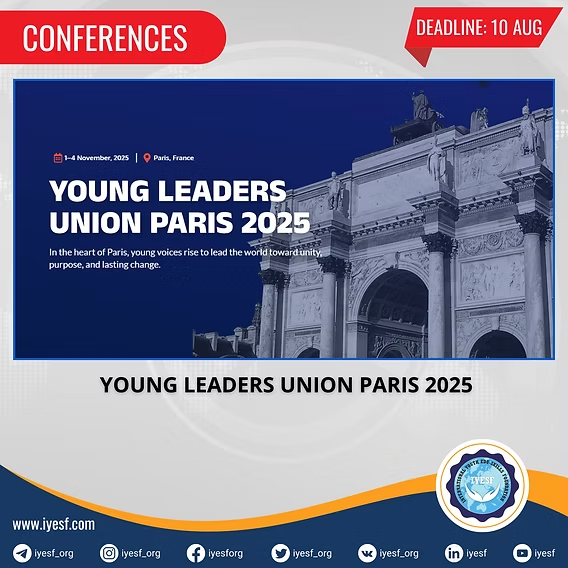
Young Leaders Union Conference 2025 in Paris (Fully Funded)
Join Global Changemakers in Paris! Fully Funded International Conference for Students, Professionals, and Social Leaders from All Nationalities and Fields

Yer yürəsinin daxili nüvəsində struktur dəyişiklikləri aşkar edilib
bu nəzəriyyənin doğru olmadığı məlum olub. Seismik dalğalar vasitəsilə aparılan tədqiqatda daxili nüvənin səthindəki dəyişikliklərə dair qeyri-adi məlumatlar əldə edilib.

Lester B Pearson Scholarship 2026 in Canada (Fully Funded)
Applications are now open for the Lester B Pearson Scholarship 2026 at the University of Toronto!